
The 4-Part Brand Strategy Framework Every Small Business Needs
The 4-Part Brand Strategy Framework Every Small Business Needs
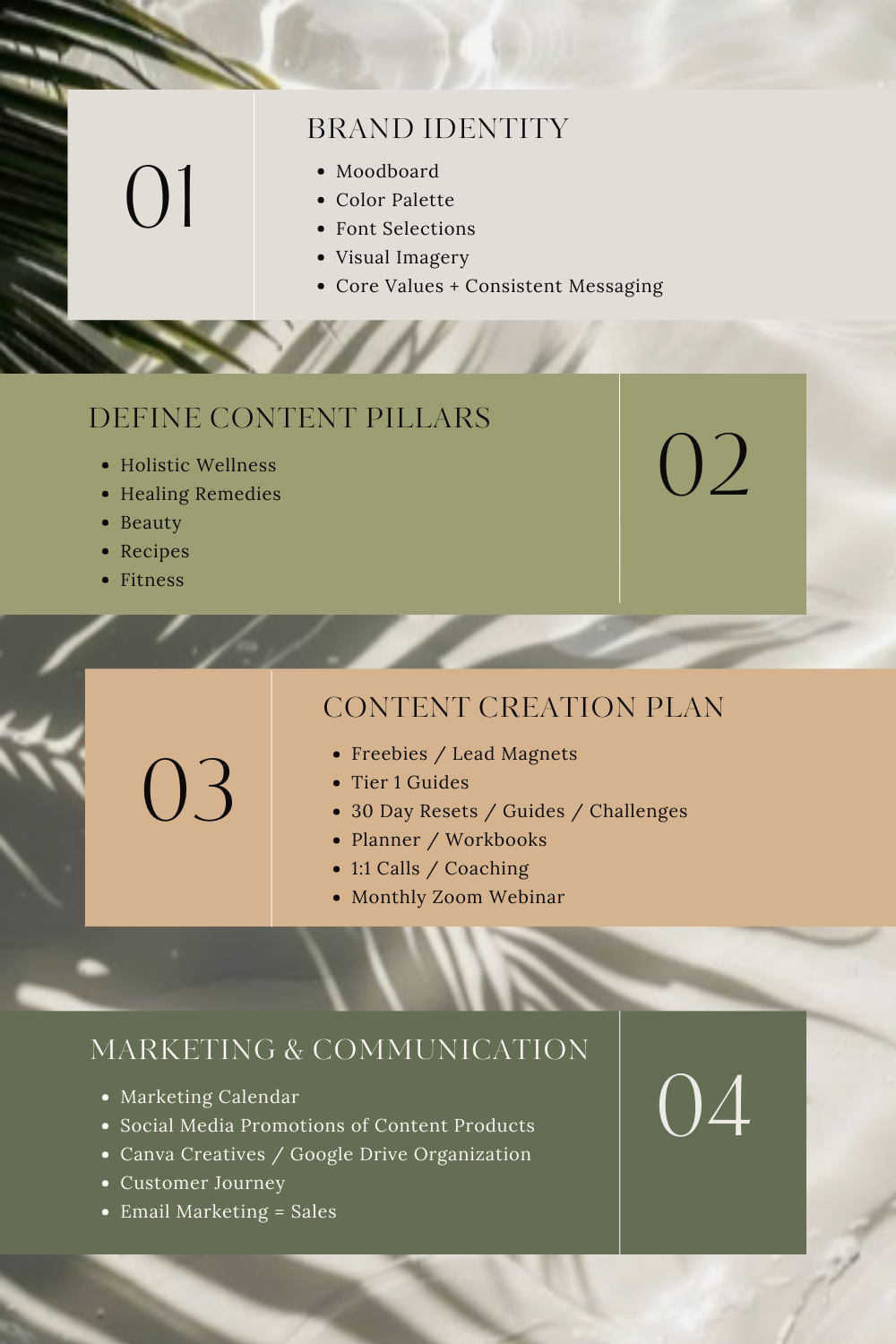
The image above?
That came directly from a content strategy proposal I created for a client in the wellness space.
Not a Pinterest template.
Not a made-up example.
A real framework I built for a real business I was preparing to help execute on. Content, offers, marketing, the whole ecosystem.
And when I zoomed out, I realized something.
This structure works far beyond wellness.
Because the industry might change, but the foundation of a strong brand don’t.
Right now, wellness is loud. Saturated. Aesthetic-heavy. Every other week there’s a new reset, detox, or “method.”
And most of it looks the same.
Which is exactly why brand strategy matters.
Aesthetics alone will not carry you in a crowded market.
So let’s break down what a real brand strategy actually includes.
Not vibes.
Not just a logo.
Not random content ideas.
A full ecosystem.
If your business feels scattered, inconsistent, or harder than it should be, chances are one of these four pieces is missing.
1. Brand Identity (This Is the Foundation)
In wellness, brand identity often looks like:
Soft neutrals or earthy greens
A clean moodboard
Serif fonts
Botanical imagery
And there’s nothing wrong with that.
But brand identity is more than aesthetic.
It includes:
Moodboard
Color palette
Font selections
Visual imagery
Core values
Consistent messaging
The mistake most small businesses make?
They confuse aesthetic with identity.
A moodboard is not a strategy.
If you’re a holistic nutrition coach, your identity needs to align with:
Your philosophy
Your tone
Your approach to health
Are you clinical and science-based?
Intuitive and spiritual?
Practical and no-nonsense?
That decision shapes everything visually and verbally.
If your visuals say “calm intuitive healer” but your messaging is sharp and science-heavy, your brand will feel off, even if it looks beautiful.
Brand identity should reflect positioning. Not trends.
Without this alignment, your brand feels scattered.
2. Define Content Pillars
Content pillars are the themes you consistently talk about. They build authority over time.
For a wellness brand, that might be:
Holistic wellness
Healing remedies
Beauty from within
Recipes
Fitness
But here’s the key:
Your pillars must support your positioning.
If you’re a hormone-focused coach, random smoothie recipes dilute your expertise.
If you’re a gut health expert, your content should consistently reinforce that focus.
The other common mistake? Making pillars too broad.
If your pillars are “health,” “mindset,” and “life,” you’ll end up posting whatever feels good that day.
Content pillars are strategic. Not random.
They should:
Reinforce your expertise
Support your offers
Build depth over time
When done properly, they make content easier. Not harder.
3. Content Creation Plan
This is where you move from posting to building assets.
In wellness, that might include:
Free guides
Lead magnets
30-day resets
Digital planners
1:1 coaching
Monthly webinars
This is how you turn content into offers.
Here’s a hard truth:
Posting on Instagram is not a content strategy.
Building assets that compound over time is.
If you’re constantly posting but not creating structured products, email funnels, or intentional offers, you don’t have a strategy.
You have activity.
And activity feels busy. Strategy builds momentum.
Your content creation plan should answer:
What free value brings people in?
What paid offer moves them forward?
What transformation do you guide them through?
Without this layer, your content doesn’t lead anywhere.
4. Marketing & Communication
This is where most people burn out.
Because now you have to:
Create a marketing calendar
Promote your offers
Organize your Canva files
Map your customer journey
Use email marketing intentionally
This is the operational side of brand strategy.
And yes, it matters just as much as your moodboard.
Most businesses don’t actually have a marketing problem.
They have a follow-through problem.
They create something once and assume people saw it.
They don’t repeat messaging.
They don’t nurture.
They don’t connect content to sales intentionally.
Marketing and communication is about consistency and structure.
Without it, even a strong brand won’t grow.
Why This Works in Wellness (And Anywhere Else)
The reason this framework resonates in wellness is because the industry is saturated.
People see:
Pretty branding
Viral posts
Massive wellness influencers
But they don’t see the structure behind it.
That structure is what sustains the brand long term.
And this 4-part framework works for:
A wellness coach
A kids party decor Etsy shop
A baby photographer
A home baker
A brand strategist
The industry changes.
The structure doesn’t.
If You’re in a Saturated Market
Wellness is saturated.
So is photography.
So is coaching.
So is Etsy.
You do not win by being louder.
You win by being clearer and more structured.
That’s brand strategy.
Without structure, you end up:
Redesigning constantly
Pivoting offers every six months
Posting randomly
Feeling behind
With structure, you:
Build momentum
Make clearer decisions
Create consistency
Stop second-guessing everything
This is the difference between a brand that looks good and a brand that holds up.
And it’s exactly the kind of foundational work we build inside Move It Along Studio and inside Build Your Brand in 45 Days.
Because once the structure is in place, everything else gets easier.
This framework isn’t theoretical.
It’s the structure behind the work I do with clients.
It’s also the backbone of Build Your Brand in 45 Days.
Because before you worry about growth hacks or trending content, you need structure.
You need positioning.
You need aligned content pillars.
You need an offer ecosystem.
You need marketing that actually connects the dots.
That’s what holds a brand up long term.
If you’re tired of redesigning, pivoting, or feeling like your business almost makes sense but not quite, this is where we start.
Structure first.
Then momentum.