
Brand Strategy 101: How to Define the Problem Your Small Business Solves
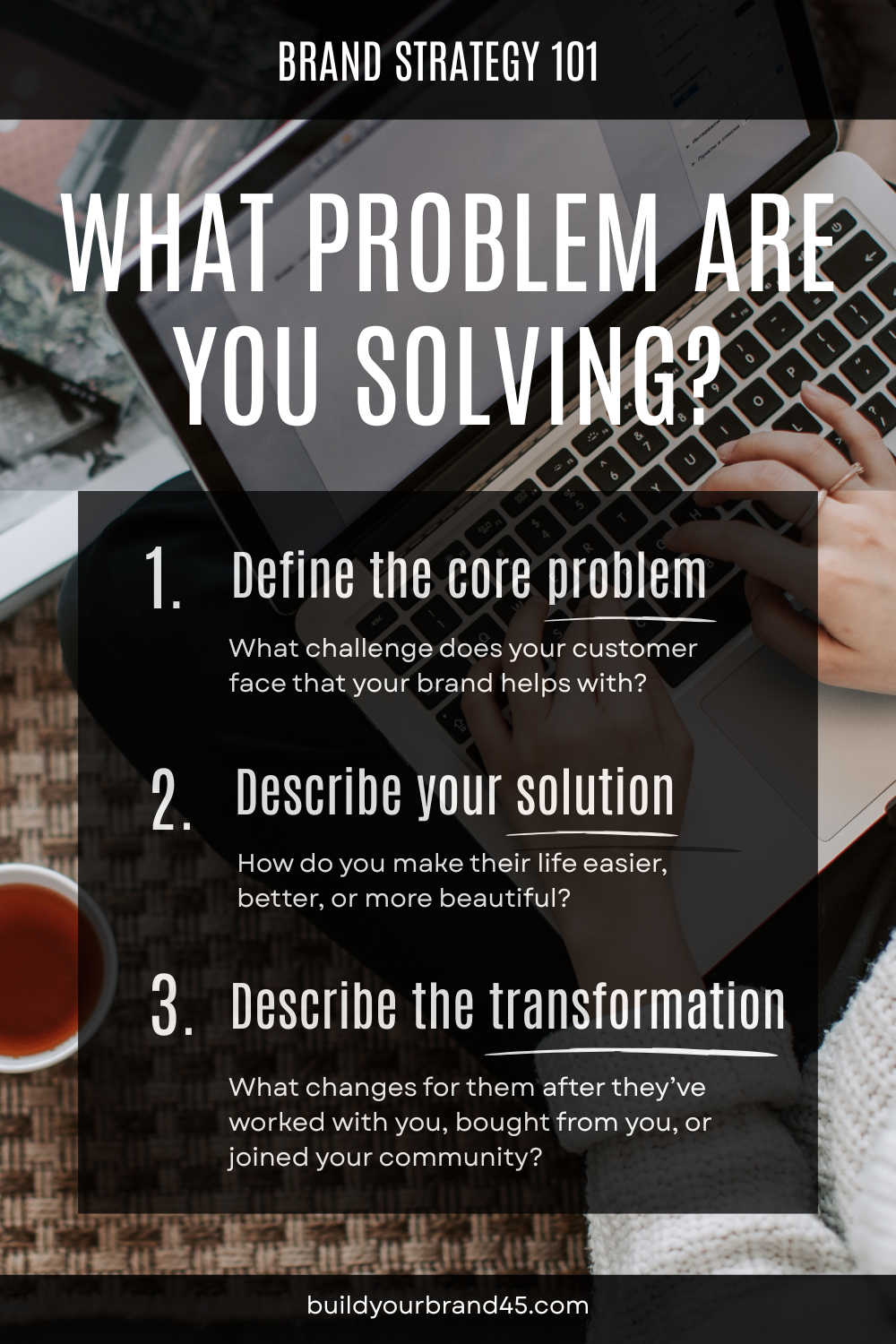
What Problem Are You Actually Solving?
(Brand Strategy 101 for Small Business Owners)
Let me say something that needs to be said.
Most small business owners are not clear on the problem they solve.
They can tell you what they sell.
They can tell you what they offer.
They can tell you what they love doing.
But when I ask,
“What problem are you solving?”
There’s usually a pause.
And that pause?
That’s where the work is.
Strong brands are not built on trends.
They’re built on clear problems and strong solutions.
And yet, most people start in the opposite place.
They design the logo.
They choose the colors.
They start posting content.
Without ever clearly defining the core problem they actually solve.
If your content feels scattered…
If your messaging feels vague…
If people say “this is nice” but don’t buy…
You probably haven’t defined the core problem clearly enough.
So let’s fix that.
Step 1: Define the Core Problem
Not the surface problem.
The real one.
Example:
Surface problem:
“I need a logo.”
Real problem:
“I don’t feel confident showing up because my brand looks pieced together and amateur.”
Surface problem:
“I need help with Instagram.”
Real problem:
“I don’t know how to talk about what I do in a way that makes people care.”
Surface problem:
“I need a website.”
Real problem:
“I’ve outgrown DIY and my business doesn’t reflect the level I’m actually operating at.”
See the difference?
The core problem is usually emotional + practical.
It’s frustration.
Overwhelm.
Insecurity.
Stagnation.
Wasted time.
Missed revenue.
If you can name that clearly, your messaging gets sharper overnight.
Ask yourself:
What is my customer tired of?
What feels heavy for her right now?
What is she Googling at 10pm?
What has she already tried that didn’t work?
That’s your starting point.
Step 2: Describe Your Solution (Without Being Generic)
Please don’t say:
“I help women step into their power.”
Be specific.
What do you actually do that makes her life easier, better, smoother, more profitable, less chaotic?
For example:
Instead of
“I help small businesses with branding.”
Try
“I help overwhelmed small business owners organize their ideas, refine their message, and build a brand that makes sense so they stop second-guessing everything.”
Instead of
“I offer business coaching.”
Try
“I help early-stage founders simplify their offers, clarify what they’re selling, and create a content plan they can actually keep up with.”
Your solution should feel tangible.
It should answer the question:
“What changes in my day-to-day life if I work with you?”
If the answer is vague, your marketing will be too.
Step 3: Describe the Transformation
This is the part most people rush.
Transformation is not “more followers.”
Transformation is not “a new logo.”
Transformation is identity-level.
Before:
Scattered messaging
Posting randomly
Undercharging
Doubting everything
Feeling behind
After:
Clear positioning
Confident offers
Aligned content
Consistent brand visuals
Decisions feel easier
The transformation is clarity in action.
It’s momentum.
It’s moving from reactive to intentional.
When someone works with you, buys from you, joins your community, what is different six months later?
If you can’t articulate that clearly, you’re not done with your brand strategy yet.
Why This Matters More Than Your Color Palette
Your fonts matter.
Your visuals matter.
Your website matters.
But none of that works if people don’t feel understood.
People buy when they feel seen.
When they read your content and think,
“Okay. She gets it.”
Not when they think,
“This looks pretty.”
If your brand isn’t converting, don’t start with Canva.
Start here.
What problem are you solving?
For who?
And what actually changes because of you?
A Reality Check for Beginners
If you’re just starting out, this might feel overwhelming.
That’s normal.
You don’t have to get it perfect on day one.
But you do have to think about it.
Because if you skip this step, you’ll:
Redesign your brand three times
Rewrite your bio every month
Pivot your offer every quarter
Feel like you’re constantly starting over
And it’s exhausting.
Strong brands are not built on trends.
They’re built on clear problems and strong solutions.
Everything else is execution.
If You Want to Do This Properly
Take one hour.
Open a Google Doc.
Answer these three prompts honestly:
The real problem my customer has is…
The specific way I solve it is…
After working with me, she can finally…
Not the polished version.
The honest version.
That’s your foundation.
And from there, your content gets easier.
Your offers get stronger.
Your brand starts to feel grounded instead of scattered.
That’s brand strategy 101.
And if you’ve been feeling all over the place lately,
this is probably the reset you needed.